
Problem
Open on something your reader already lives with, before your coffee shows up anywhere.
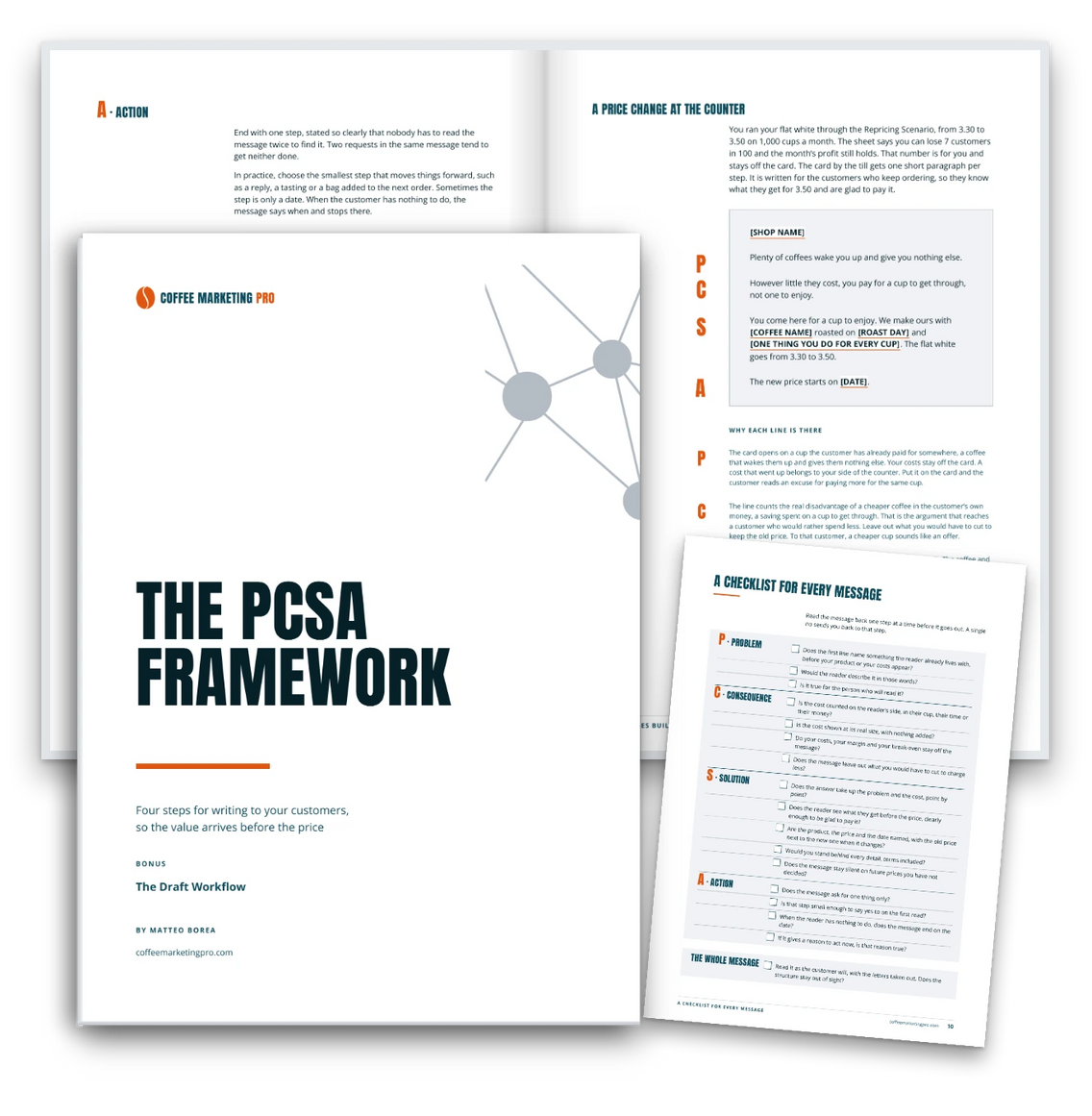
The PCSA Framework is a four-step structure for the messages you write to your customers. Problem, Consequence, Solution and Action, always in that order, so the value arrives before the price. Matteo Borea created it and still writes with it.
The file works, or your money back
Haven't downloaded it yet? Full refund within 14 days of purchase, no questions asked.
Downloaded it and it doesn't work, or you can't use it because of us? Write to info@coffeemarketingpro.com within 48 hours of the download and show us what's wrong. Full refund.
It covers a file that doesn't work, not a file you'd have built differently. Refund policy

P · PROBLEM
You choose the coffee, you set the recipe and you decide what happens to every cup before it leaves the bar. Your customer sees a price on a card by the till, a line on a bag or a figure in an email. What that price buys them stays on your side of the counter until somebody writes it down. Most days that somebody is you, at the end of a shift.
C · CONSEQUENCE
A price that reaches a customer before its value gets measured against the only other prices they know, down the street and on the grocery shelf. From there it gets defended one question at a time at the till, and the card that should take four lines takes an evening. The same evening comes back with a proposal to a coffee shop that already buys somewhere else. The easy version blames the cost of milk and asks the customer to pay for it.
S · SOLUTION
The PCSA Framework is a structure for any message you write to a customer, from a card by the till to a proposal for a new account. The channel changes the length of the message. The order of the steps stays the same.
Open on something your reader already lives with, before your coffee shows up anywhere.
Show what that costs them if nothing changes, counted in their money, their time or their cup.
Bring in your answer and show what they get, with details they can taste or check, before you name the price.
Close on one step, small enough to say yes to on the first read.
When the message carries a price, the four steps keep the reasons on the customer's side. Your costs stay where they belong, on your invoices.
One of the four messages, as it comes. A counter card for a flat white going from 3.30 to 3.50, one short paragraph per step, written for the customers who will keep ordering it.
[SHOP NAME]
Plenty of coffees wake you up and give you nothing else.
However little they cost, you pay for a cup to get through, not one to enjoy.
You come here for a cup to enjoy. We make ours with [COFFEE NAME] roasted on [ROAST DAY] and [ONE THING YOU DO FOR EVERY CUP]. The flat white goes from 3.30 to 3.50.
The new price starts on [DATE].
The pages next to it explain why every line is there, so the card you write after this one is your own.
A single PDF, twenty-one pages, framework and bonus together, downloaded the moment checkout is complete.
Owners who write to their own customers. The coffee shop putting a new price on the card, the micro roastery going after an account that already buys somewhere else, anyone sitting on a message they keep putting off. It assumes you already know what makes your coffee worth what you charge. These pages put that in front of the customer, in the order that gets it read.
A structure you keep using after the first message, from the next price change to the next bag on the shelf. Every card, email and product page starts from an order that is already decided instead of a blank screen. The price is the same for everyone who buys it, with no discount to wait for.

It will not tell you what to charge. Working out what a cup costs and what a new price does to your month is a different job. It will not write the message for you either, since the details that make a price worth paying are the ones only you can check. It gives you the order, the examples and the checks.
FAQNo. These pages carry the reason for a price to the customer, on their own.
The order changes and the voice stays yours. The four steps put what your reader already lives with first, and the price after the reason that holds it up.
No. The framework works with a pen and a card. The bonus is there for the days you want a first draft on the screen, and the seven checks at the end are what turn that draft into your message.
A PDF, downloaded the moment checkout is complete. It opens in Adobe Acrobat Reader or in Preview on a Mac.
A · ACTION
It opened on something you live with, a price that reaches the customer before you can say what it buys. It counted what that costs at the till. The four steps and the pages that hold them are the answer. The line below is the action.
The next price change, the next bag on the shelf and the next shop you want as an account all need a message. You can write each one from a blank screen the evening before, or you can start from four steps already in order, with four messages written out to work from.
The file works, or your money back
Haven't downloaded it yet? Full refund within 14 days of purchase, no questions asked.
Downloaded it and it doesn't work, or you can't use it because of us? Write to info@coffeemarketingpro.com within 48 hours of the download and show us what's wrong. Full refund.
It covers a file that doesn't work, not a file you'd have built differently. Refund policy